|
-
13th December 25, 12:03 PM
#1
Late 19th/Early 20th Cent. evening wear?
Paging @OC Richard . 
My wife and I are attending a function in March, the theme of which is the Art Nouveau/Aestheticism period. The dress code reads, "Art Nouveau and Aestheticism inspired, 1870-1910 dress." My wife is making her own, very elaborate dress, period-approximate, and from what I know of likely attendees, most of the focus will be on the women. :-) The easy thing for me to do would be to go white tie and tails, but I also started to wonder if I could piece together a kilted outfit.
As near as I can tell, if I went with buckle brogues, diced hose, kilt, horsehair sporran, and Balmoral doublet I'd be good. Everything except the doublet is either easy to acquire or in my possession already.
So - any other doublets or jackets that would get me in the ballpark for an 1870-1910-ish outfit? Any good resources for photos from that time period? Other thoughts, suggestions or critiques? All are welcome, and thanks in advance for your input.
-
-
13th December 25, 01:04 PM
#2
Sorry - wrong forum (I think)
Going to re-post in the "Historical Kilt Wear" forum.
-
-
13th December 25, 01:05 PM
#3
Late 19th/Early 20th Century evening wear?
Paging @OC Richard .
My wife and I are attending a function in March, the theme of which is the Art Nouveau/Aestheticism period. The dress code reads, "Art Nouveau and Aestheticism inspired, 1870-1910 dress." My wife is making her own, very elaborate dress, period-approximate, and from what I know of likely attendees, most of the focus will be on the women. :-) The easy thing for me to do would be to go white tie and tails, but I also started to wonder if I could piece together a kilted outfit.
As near as I can tell, if I went with buckle brogues, diced hose, kilt, horsehair sporran, and Balmoral doublet I'd be good. Everything except the doublet is either easy to acquire or in my possession already.
So - any other doublets or jackets that would get me in the ballpark for an 1870-1910-ish outfit? Any good resources for photos from that time period? Other thoughts, suggestions or critiques? All are welcome, and thanks in advance for your input.
-
The Following User Says 'Aye' to carlb For This Useful Post:
-
13th December 25, 03:02 PM
#4
 Originally Posted by carlb

Paging @ OC Richard .
My wife and I are attending a function in March, the theme of which is the Art Nouveau/Aestheticism period. The dress code reads, "Art Nouveau and Aestheticism inspired, 1870-1910 dress." My wife is making her own, very elaborate dress, period-approximate, and from what I know of likely attendees, most of the focus will be on the women. :-) The easy thing for me to do would be to go white tie and tails, but I also started to wonder if I could piece together a kilted outfit.
As near as I can tell, if I went with buckle brogues, diced hose, kilt, horsehair sporran, and Balmoral doublet I'd be good. Everything except the doublet is either easy to acquire or in my possession already.
So - any other doublets or jackets that would get me in the ballpark for an 1870-1910-ish outfit? Any good resources for photos from that time period? Other thoughts, suggestions or critiques? All are welcome, and thanks in advance for your input.
Hmmmm ... Art Nouveau kilt.
Hmmmmmmm.
Last edited by Canadian Vet; 13th December 25 at 03:03 PM.
Reason: misspelling
-
-
13th December 25, 08:10 PM
#5
Originally Posted by carlb
Going to re-post in the "Historical Kilt Wear" forum.
Would you like us to merge the two threads for you?
Rev'd Father Bill White: Mostly retired Parish Priest & former Elementary Headmaster. Lover of God, dogs, most people, joy, tradition, humour & clarity. Legion Padre, theologian, teacher, philosopher, linguist, encourager of hearts & souls & a firm believer in dignity, decency, & duty. A proud Canadian Sinclair.
-
-
14th December 25, 06:16 AM
#6
Last edited by OC Richard; 16th December 25 at 08:24 PM.
Proud Mountaineer from the Highlands of West Virginia; son of the Revolution and Civil War; first Europeans on the Guyandotte
-
-
14th December 25, 09:24 PM
#7
Here I am!
There's a book which is a perfect time-capsule for Highland Dress in the period you asked about.
It was published in 1914. Little did the author know that the dress he describes in such detail would be nearly extinct by the end of that decade, by 1920.
It's a small thin book titled
The Kilt
A Manual of Scottish National Dress
by
Loudon MacQueen Douglas FRSE FSA Scot.
In his description of Evening Dress he gives the Doublet, which was the nearly universal formal jacket from at least the mid-19th century until new Evening jackets begin appearing in the 20th century.
Today we call the civilian Evening doublet the "Regulation Doublet" which is a puzzling name for a purely civilian jacket. It was always just called a "doublet" in the old days.
He does go on to say:
In place of the Doublet some Scottish dresses have a Coatee, or short coat with abbreviated tails like a Morning Coat. It is quite optional whether this is worn, or the Doublet.
Any form of the Coatee, however, is entirely modern and personally I prefer the Doublet.
Of course he's referring to the thing which by the 1920s was being called the Prince Charlie Coatee.
By the way, writers from the 1920s and 1930s repeatedly stress that the Coatee is only suitable for "youths" and "slim young men" and not suitable for "older gentlemen".
Continuing with his list of Evening Dress elements:
The Plaid.
The plaid is merely ornamental but should always be worn with Evening Dress. (By 1920 plaids had fallen from favour.)
The Tie etc.
The adopted form of scarf is the Lace Jabot, and the modern combination is with the Jabot and the ordinary starched collar.
With gauntlets on the sleeves it is not necessary to wear Lace Ruffles. (He's referring to the "gauntlet cuffs" on the Doublet.)
Stockings and Foot Wear.
Stockings used to be made out of the web of tartan but are now knitted and can be obtained in any pattern.
Boots never should be worn with Evening Dress; brogues, preferably with silver buckles, are the most convenient.
So he's specifying knit tartan hose to match the kilt and buckle brogues, which have continued to be worn in Evening Dress to this day.
Cap.
The best form of cap to accompany Evening Dress is of the flat circular Balmoral shape.
(There was an Edwardian fad for wide flat bonnets.)
Ornaments.
In addition to the Shoulder Brooch there should be a Dirk. The (dirk) belt is fastened around the waist under the vest. (The term "waistcoat" was in the future.)
(He mentions the Sgian dubh.)
The Sporran for Evening Wear should be goat's hair with tassels. Small circular sporrans are more suitable for Morning Wear than otherwise. (Morning Wear is what we call Day Dress.)
Other ornaments may consist of a Claw Brooch to fasten the edges of the kilt, but this is highly objectionable for dancing as the claw is apt to catch the dresses of the Ladies. The simplest fastener for the kilt is a large silver safety pin.
He likewise goes on to discourage wearing of the other Victorian ornaments such as sword belts and swords, dirk belts with Highland pistols, and powder horns.
So we're in a transitional phase. By the 1920s the plaids and dirks would be gone too.
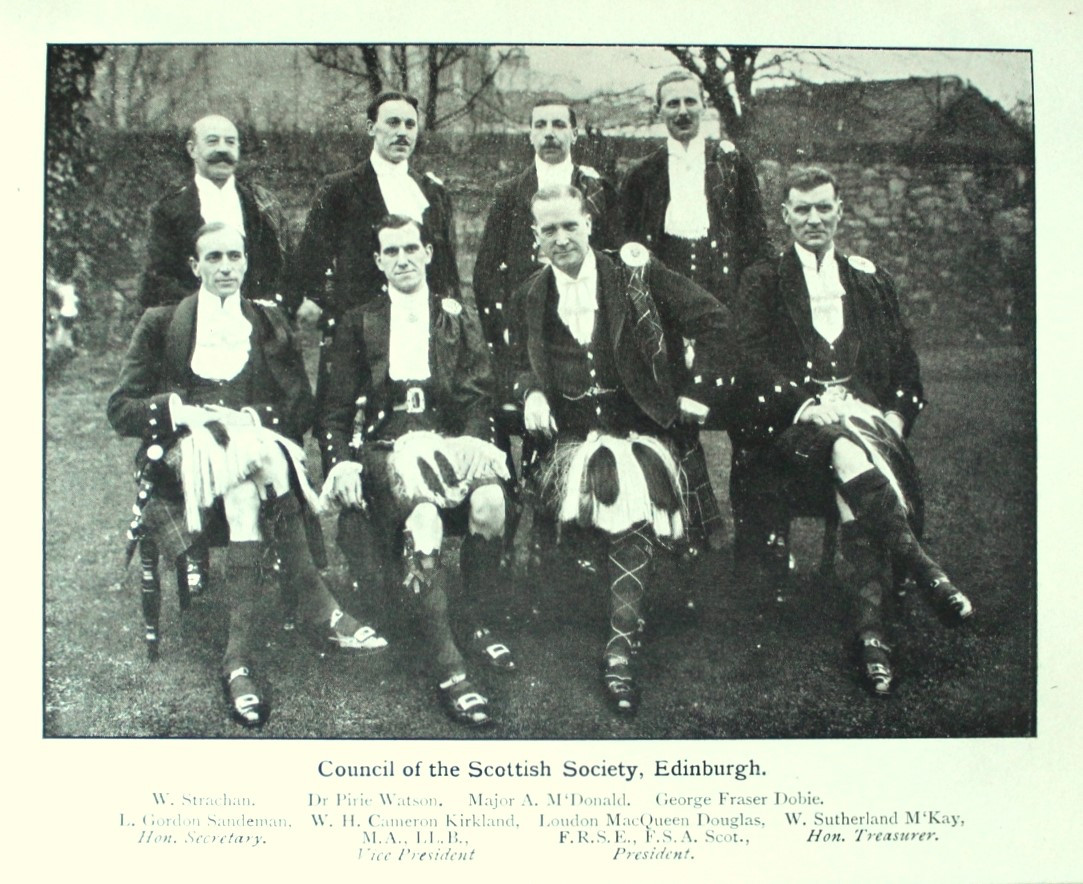
Here's the author and other gents in the form of Evening Dress he describes. (The gent front row, 2nd from left, might be wearing the Coatee. The others are wearing Doublets.)
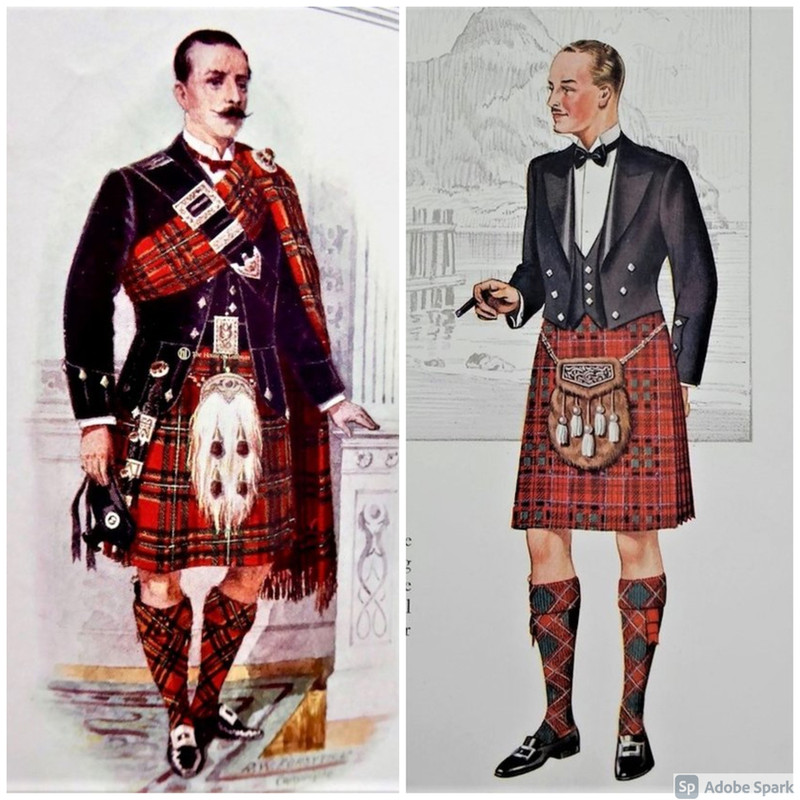
Here's a gent in a c1905 catalogue showing most of the old Victorian Evening Dress ornaments, and from a c1930 catalogue showing World War One's impact on Highland Evening Dress. The only things that remain unchanged are the shirt, kilt, tartan hose, sgian, and Cromwell shoes.
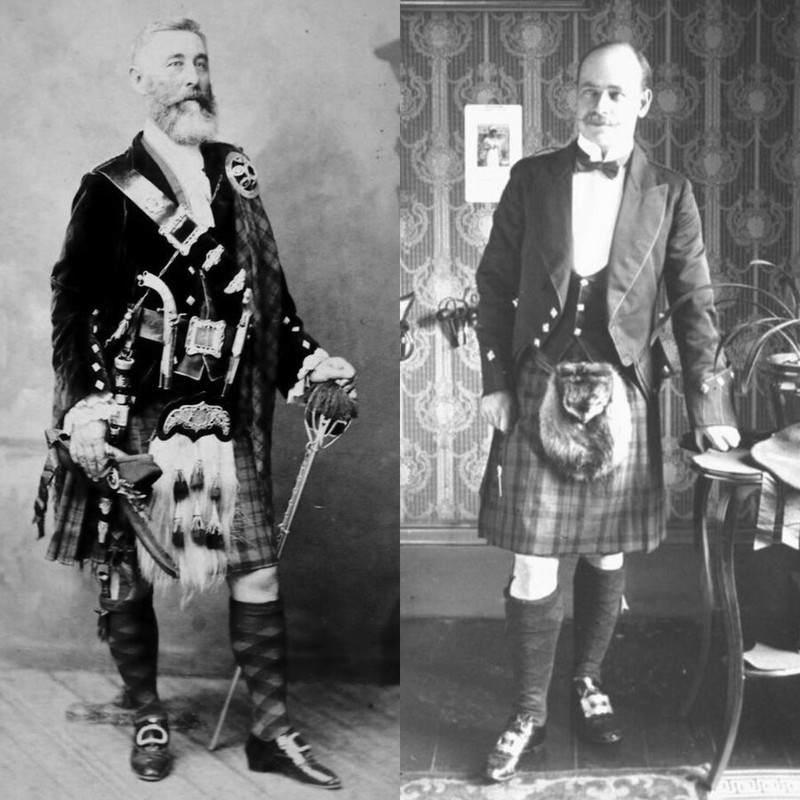
Even more transformation is seen with this gent wearing the full Victorian panoply of "ornaments" (left) and a c1930 gent showing nearly all of this stuff abandoned, his only "ornaments" being a kilt pin and sgian.
Your period is smack dab in between these two extremes.
Last edited by OC Richard; 14th December 25 at 09:31 PM.
Proud Mountaineer from the Highlands of West Virginia; son of the Revolution and Civil War; first Europeans on the Guyandotte
-
The Following 2 Users say 'Aye' to OC Richard For This Useful Post:
-
16th December 25, 09:54 AM
#8
Originally Posted by Father Bill
Would you like us to merge the two threads for you?
If it's not too much trouble, that would be great. Thank you!
-
-
16th December 25, 10:04 AM
#9
Originally Posted by carlb
If it's not too much trouble, that would be great. Thank you!
Done. Had to remember how to do it - it's been a while.
Rev'd Father Bill White: Mostly retired Parish Priest & former Elementary Headmaster. Lover of God, dogs, most people, joy, tradition, humour & clarity. Legion Padre, theologian, teacher, philosopher, linguist, encourager of hearts & souls & a firm believer in dignity, decency, & duty. A proud Canadian Sinclair.
-
The Following User Says 'Aye' to Father Bill For This Useful Post:
-
16th December 25, 10:12 AM
#10
@OC Richard, thank you!
That was exactly the kind of thing I was looking for. I had seen an earlier post from you with a catalog of clothing from the 1930s, which seemed just a tad too late. This is perfect!
Distilling this down, here's what I take from the information you gave. If I want to be reasonably period-appropriate, I could go with (from top down):
- Prince Charlie coatee and waistcoat
- Plaid (see question below)
- White shirt with wing collar
- Lace jabot
- Wool kilt (mine's in MacLeod of Harris)
- Dirk and dirk belt (optional; see question below)
- Horsehair sporran
- MacLeod tartan hose (see question below)
- Sgian dubh
- Buckle brogues
I know the gentleman above says that coatees are for slender young men (of which I am neither), but it seems like that was becoming more the standard toward the latter part of the period in question, and it would be a garment I could wear on other occasions.
So - my questions:
- It's difficult for me to tell from the black-and-white photo, but it looks like the gentlemen in the photo are all wearing what we would now call a fly plaid. Do you think that's right?
- I assume that the dirk would be worn using frogs, suspended from my usual kilt belt. Is that correct? It probably doesn't matter; I doubt I will go to the trouble of acquiring a dirk, but who knows?
- Since the gentlemen mentions that hose, "are now knitted and can be obtained in any pattern," could diced hose be considered appropriate?
Again, many thanks! I've got a lot more to work with than I did when I started thinking about this. 
Last edited by carlb; 16th December 25 at 10:16 AM.
-
 Posting Permissions
- You may not post new threads
- You may not post replies
- You may not post attachments
- You may not edit your posts
-
Forum Rules
|
|





 Reply With Quote




Bookmarks