|
-
30th January 26, 12:38 PM
#1
Before the Kilt
How did Scots dress before the kilt, was it have been somethig like this picture?

Steve
Clan Lamont USA
SR VP & Central US VP
-
-
30th January 26, 03:08 PM
#2
I have no idea, I am afraid that period was way before my time! 
" Rules are for the guidance of wise men and the adherence of idle minds and minor tyrants". Field Marshal Lord Slim.
-
The Following 4 Users say 'Aye' to Jock Scot For This Useful Post:
-
30th January 26, 03:57 PM
#3
If you're interesting in researching the subject I highly recommend the book
Old Irish & Highland Dress
by H. F. McClintock
Dundalgan Press, Dundalk 1950
(There was an earlier edition, 1943.)
Surprisingly in spite of its age, and the near-certainty that not many were printed this book is still fairly available and not terribly expensive.
The main thrust of the book is that Highland Dress and the now-extinct old Irish dress must be viewed together as part of a larger Gaelic cultural region.
The author begins the section on Highland Dress by saying
Very little seems to be ascertainable about Highland costume before the 16th century. No descriptions of any value by contemporary writers appear to remain. The most likely source of information would seem to be from carvings on the early Christian crosses and monuments to be found in many parts of Scotland.
In addition to the Scriptural and ecclesiastical figures which appear on many of these stones there are others which are purely secular, such as hunting and battle scenes, archers and horsemen with sword, spear and shield etc.
...a detailed knowledge of early Scottish history and racial distribution would be needed in order to decide which features of dress are definitely Highland, i.e. Gaelic, and which might be due to Saxon, Scandinavian, or some other outside culture.
For the rest one must turn to Ireland for information about the older forms of Gaelic dress.
There he's referring to the ancient Irish Brat and Leine costume.
'Leine' in Gaelic, resembling a shirt or smock, is often described as being hooded...its colour is almost always described by the Irish word 'gel' meaning bright or light-coloured and was probably white, but occasionally a coloured border or red embroidery is mentioned.
'Brat' in Gaelic was an outer garment thrown around the body and fastened at the breast with a brooch. A variety of colours (though not white) are mentioned but there is no clear evidence as to its shape or size, nor, though" varigated" and "many-coloured" mantles are often spoken of, is there sufficient evidence to claim that the patterns were tartan.
A girdle ('Crios') is often mentioned being worn...
Trews or tight breeches of various lengths seem to have been worn in Ireland since at least the 10th century...
Both Brat and Leine continued in use in Ireland till the end of the 16th century with the addition of jackets both short and long and trews.
The Brat or mantle was usually semi-circular and made of stout woolen cloth of various colours, often with a long shaggy pile on its surface for extra warmth, and with fringes often of a different colour than the mantle.
The Leine was considerably altered, the colour nearly always saffron yellow. It was generally known by the English as the "Saffron shirt".
Last edited by OC Richard; 30th January 26 at 03:59 PM.
Proud Mountaineer from the Highlands of West Virginia; son of the Revolution and Civil War; first Europeans on the Guyandotte
-
The Following 2 Users say 'Aye' to OC Richard For This Useful Post:
-
30th January 26, 04:02 PM
#4
-
The Following 3 Users say 'Aye' to OC Richard For This Useful Post:
-
30th January 26, 05:02 PM
#5
That last picture and the gent 2nd from the left is close to what I have seen for the Germanic and Scandivian countries.
I guess with similar weather they wore about the same style of clothes in the 11th and 12th centuries.
Steve
Clan Lamont USA
SR VP & Central US VP
-
-
31st January 26, 07:12 AM
#6
I just finished the chapter The Highland Tradition of Scotland by Hugh Trevor-Roper from Eric Hogsbawm and Trrence Rangers book The Invention of Tradition. In it, Mr. Trevor-Roper contends that the people of the highlands were culturally Irish until the latter years of the 17th century. Henry VIII's government banned Irish dress in 1537 (google told me that), and we see the first evidence of the plaid being worn as a belted garment in the 1500s, but I haven't internalized dates and sources for that, yet. I am building my resources now to better understand this topic.
The philibeg (the kilt we know today) didn't appear until between 1727 and 1734 by the accounts that Thomas Rawlinson created the tailored little kilt while leasing land in Scotland for his iron smelting operation. Before that, many people wore the belted plaid, what we call the great kilt today, or trews.
I imagine that lots of people also wore lowland and Saxon clothing, too, if they had the money for it. King Charles II popularized wearing breeches, waistcoats and jackets around 1666, and that probably filtered its way into Scotland. So, before the philibeg, they probably saw "Saxon wear" in the highlands to some degree.
I'll try to get my sources in order, soon.
-
The Following User Says 'Aye' to bookish For This Useful Post:
-
1st February 26, 10:23 AM
#7
Authors of costume books seem rather relieved to report that the Scots adopted English and French garments and fashions when they get past Gauls Vikings and Romans, which seems to be the accepted progression in the major works. Hopefully modern authors are more inclusive and accurate in their depictions.
Anne the Pleater
I presume to dictate to no man what he shall eat or drink or wherewithal he shall be clothed."
-- The Hon. Stuart Ruaidri Erskine, The Kilt & How to Wear It, 1901.
-
The Following User Says 'Aye' to Pleater For This Useful Post:
-
31st January 26, 02:05 PM
#8
 Originally Posted by OC Richard

There were some illustrations done of the old Irish clothing prior to it being regulated out of existence by the English. (There were numerous laws passed banning this dress and requiring ordinary English dress.)
Here you can see the Leine (saffron shirt) gathered at the waist by a Crios (belt, which survives in the Aran Islands), the Ionar (jacket), and Brat (mantle with shaggy fringe).
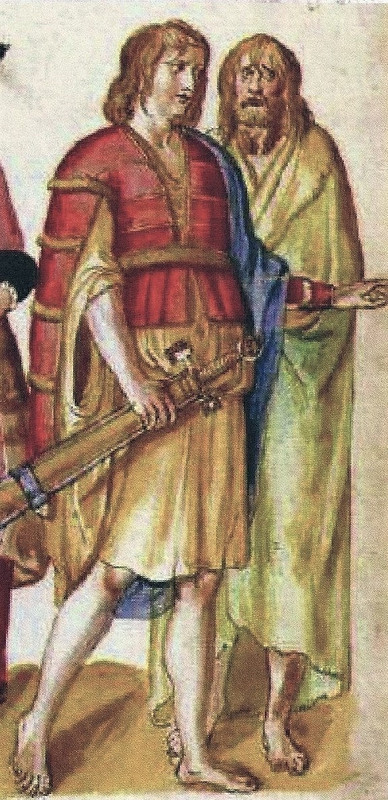
Here, around 1570, showing the short trews (which also appear in The Book Of Kells). Is the Ionar intended to be tartan? Who can say.
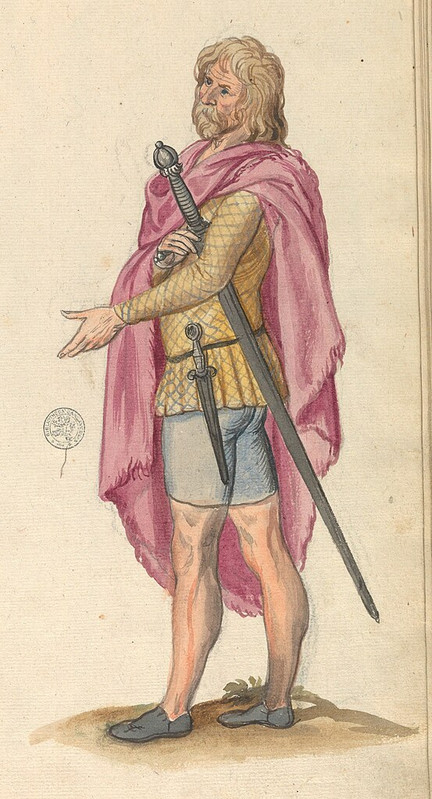
My theory is that sometime after the cutting of cultural exchange between the Irish and Scottish Gaels, for some unknown reason the Scottish Gaels began wrapping the Brat around their waist and fastening it in place with a belt.
It's not a huge leap from the Irish Gaelic costumes above to these 17th century Highland soldiers. (Scots Gaels, and their language, were often called "Irish".)
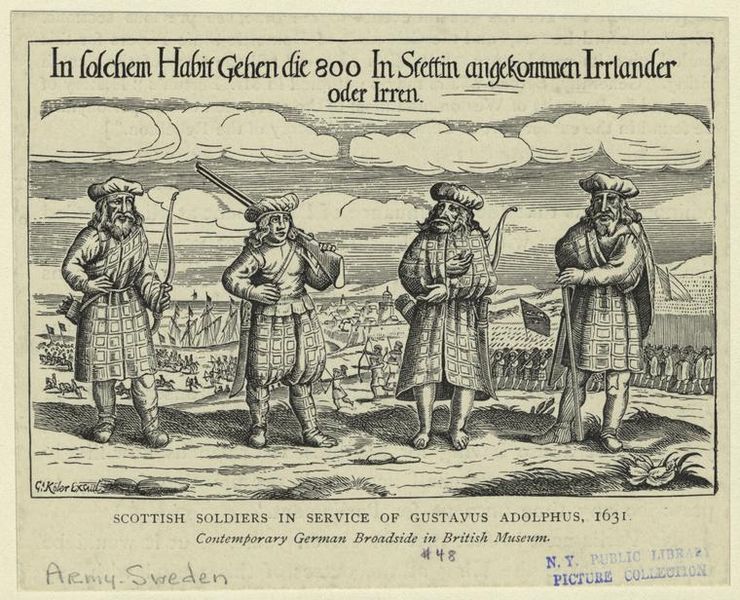
"Sometime after the cutting of the cultural exchange"...
My understanding was the 1st documented accounts of the Belted plaid was about Highland and Island Mercenaries fighting in Ireland, which doesn't meet the criteria for "cutting of the cultural exchange"..
-
The Following User Says 'Aye' to Allan Thomson For This Useful Post:
-
31st January 26, 12:33 PM
#9
The ancient Scots were dismissed by the writers of all the books on costume I've acquired as being very primitive in their dress - their oldest form of attire seems to have been a deerskin made into a cagoule by peeling it off the animal after cutting open the hind part and chopping off the head so it remained a tube.
Cagoule means, or implies a hood, which I am assuming would have been formed from the skin of the hind legs, mostly because they are spare parts, the right shape and what I would do with them in the circumstances. The lower front legs would perhaps have been used as footwear with a bit of shaping and stitching.
The books imply that more civilised garments were imported from further south and offered as wages for work or services and as status symbols to tame the wild men of the North.
Anne the Pleater
I presume to dictate to no man what he shall eat or drink or wherewithal he shall be clothed."
-- The Hon. Stuart Ruaidri Erskine, The Kilt & How to Wear It, 1901.
-
The Following User Says 'Aye' to Pleater For This Useful Post:
-
31st January 26, 02:19 PM
#10
Thing is, if we're talking "ancient Scots" meaning Celtic culture, the Romans commented that the Celts of Gaul and of Britannia shared language and culture.
Which means woollen cloaks and trews and linen shirts.
We have some ancient Irish clothing from bogs and the tailoring is sophisticated.
As far as written accounts, these are catalogued in Old Irish & Highland Dress.
The earliest is 1093 which mentions "short tunics and upper garments" but bare-legged.
Next we leap to 1470! When the dress is a shirt dyed with saffron, a "mantle", and once again bare-legged. In war a chain mail shirt is worn. "Wild Scots" are said to fight it "a linen garment manifoldly sewn/pleated/quilted (the exact meaning of the Latin is unsure), daubed with pitch, with a covering of deerskin."
This might "be similar to the padded acton worn as armour both in Ireland and in the Highlands".
"The practice in the Highlands of smearing clothes with tar or grease is mentioned by other writers, and was a crude kind of waterproofing."
The next mention is 1538, a list of the elements of a Highland outfit made for King James V.
Proud Mountaineer from the Highlands of West Virginia; son of the Revolution and Civil War; first Europeans on the Guyandotte
-
The Following User Says 'Aye' to OC Richard For This Useful Post:
 Posting Permissions
- You may not post new threads
- You may not post replies
- You may not post attachments
- You may not edit your posts
-
Forum Rules
|
|



 Reply With Quote






Bookmarks