|
-
25th March 26, 03:04 AM
#1
Scotland-America Tartan to Celebrate 250 Years of Cultural Ties
Announced on BBC Scotland this morning.
Might not be accessible to some of our members so I will quote the first few paragraphs and provide a link to the full article.
Students at a Scottish university have been asked to design a tartan to mark the 250th anniversary of the American Declaration of Independence.
Heriot-Watt University was invited by the Scottish government to create the tartan to symbolise historical and cultural ties between the countries.
Students from Heriot-Watt's school of textiles and design in Galashiels have submitted ideas, with the winning design to be revealed in the summer.
The design will be registered with the Scottish Tartan Authority as the official tartan of America250 - the group organising anniversary events in the US.
The first run will be produced at Lovat Mill in Hawick, with the winning student travelling to Washington DC to present the tartan.
https://www.bbc.co.uk/news/articles/cn0wdqevwdpo
Regional Director for Scotland for Clan Cunningham International, and a Scottish Armiger.
-
The Following 4 Users say 'Aye' to cessna152towser For This Useful Post:
-
25th March 26, 03:22 AM
#2
Rocky beat them to it- though not surprising that there will be multiple tartans with versions of that name.
https://www.usakilts.com/americas-25...cas-250th.html
This tartan, and all the other USA-themed tartans, demonstrate how daunting it is to create an attractive tartanlike tartan when limiting yourself to red, white, and blue.
Last edited by OC Richard; 25th March 26 at 03:25 AM.
Proud Mountaineer from the Highlands of West Virginia; son of the Revolution and Civil War; first Europeans on the Guyandotte
-
The Following User Says 'Aye' to OC Richard For This Useful Post:
-
25th March 26, 09:01 AM
#3
Should be interesting the color palate they come up with, as the article states the contributions the Scots gave to America will also be considered. To begin with 10 of the signers of the Declaration of Independence were of Scottish descent, with two Wilson and Witherspoon fresh off the boat from Scotland. Think of all the things people who trace their roots back to Scotland have given this country. Should be an interesting color pattern. Can't wait to see what they come up with.
-
-
25th March 26, 09:07 AM
#4
Tartanlike???
 Originally Posted by OC Richard

Rocky beat them to it- though not surprising that there will be multiple tartans with versions of that name.
https://www.usakilts.com/americas-25...cas-250th.html
This tartan, and all the other USA-themed tartans, demonstrate how daunting it is to create an attractive tartanlike tartan when limiting yourself to red, white, and blue.
Continuing with historical references, I'm inferring that your opinion might be along the line of a fictitious question preferred to President Lincoln's new widow:
"Other than that, Mrs. Lincoln, how did you like the play."
Returning to serious inquiry, why do you classify these tartans as "tartanlike?"
-
The Following User Says 'Aye' to jsrnephdoc For This Useful Post:
-
26th March 26, 02:58 AM
#5
Originally Posted by jsrnephdoc
why do you classify these tartans as "tartanlike?"
Maybe I didn't word things clearly, I was saying that it's challenging to design a tartanlike tartan when being limited to the specific shades of red, white, and blue used in the US flag, especially if used in three equal amounts.
By "tartanlike" I mean both the sense of looking like cloth (rather than a graphic design) and the sense of feeling within the aesthetic parameters of traditional tartans.
The failure concerning both points is what makes most of the Allen Brothers' original designs stand out as untartanlike, ungainly, and simpleminded.
Going outside of the flag-colours boundaries, say, using two or three shades of blue, would allow some sophistication/subtlety to be introduced into the design.
And not limiting yourself to three equal amounts of red, white, and blue opens up far more attractive options.
Being tartanlike means the designer having the only goal being creating attractive cloth, and not being constrained by non-tartan considerations such as needing to resemble a certain flag.
Last edited by OC Richard; 26th March 26 at 03:00 AM.
Proud Mountaineer from the Highlands of West Virginia; son of the Revolution and Civil War; first Europeans on the Guyandotte
-
The Following 2 Users say 'Aye' to OC Richard For This Useful Post:
-
26th March 26, 10:36 AM
#6
 Tartan vs. "tartanlike" Tartan vs. "tartanlike"
Originally Posted by OC Richard
Being tartanlike means the designer having the only goal being creating attractive cloth, and not being constrained by non-tartan considerations such as needing to resemble a certain flag.
I'm still puzzled. Can fabric be tartanlike, but not a true tartan? Or can a design that's not generated fabric be a tartan or is it only tartanlike?
There are aspects of Scottish tartans that are considered elemental but actually are not universal; e.g., that the design should be symmetrical on both axes, or that the stripes should be of different width.
Then there's the association with families, certainly not ancient, yet very common.
Then there's the complexity of the design, and of course there are no absolutes there, either.
Then there's the notion of symbolism in the design, presumably absent from ancient or more recent but traditional Scottish family tartans, but we read in many places that the color red was used to symbolize wealth or social stature even centuries ago.
Then there's the notion of a design being commemorative. Not traditional, but now VERY common. Done for Royal coronations, the deaths of royal princesses, or even to raise funds for charities run by the nurses of the Scottish National Health Service.
I have one kilt made from a commemorative tartan (the "Lunar" tartan, of which Barb Tewksbury is quite fond, and to which she contributed a symbolic change in the color palette). Should that be considered "tartanlike" rather than a "tartan?"
Then there are the many designs created by or cooperatively WITH fashion houses by Lochcarron. Are they by definition "tartanlike" rather than "tartan?" They come off the same looms as many "traditional" tartans (one definition of which might be that they were once woven by Wilsons of Bannockburn, whose motive was likely entirely commercial rather than historical preservation.
Could it devolve to something as simple as "was the design ever used to create actual fabric?"
Or, is the most appropriate descriptor the oft quoted "no generalization is worth a damn, including this one?"
I don't know that history provides much guidance. For example, what motivated the spouses of centuries-ago sheepherders to combine the locally-available pigments as they did making woolen fabric to keep their husbands warm at night but keep their weapons available during the daytime, other than just "those were the colors available?"
I see that Peter MacDonald has read your post. Perhaps he might offer an opinion.
And, please understand that I'm not trying to be obnoxious, just trying to learn.
-
-
26th March 26, 08:53 PM
#7
Oh for goodness sake! Do we really need more tartan designs?
" Rules are for the guidance of wise men and the adherence of idle minds and minor tyrants". Field Marshal Lord Slim.
-
The Following 8 Users say 'Aye' to Jock Scot For This Useful Post:
-
30th March 26, 04:55 AM
#8
Originally Posted by jsrnephdoc
...the association with families...
Recall that with what I suppose could be called the "traditional Clan tartans" the tartans came first, mostly Wilsons designs. These were created with the only goals being to look attractive and to sell.
These tartans were originally known by number, or given fanciful marketable names like "Rob Roy" and "Robin Hood".
It was later, when people were gearing up for the 1822 Royal visit, that these numbered tartans began being adopted by various Clans.
Originally Posted by jsrnephdoc
...the complexity of the design...there are no absolutes there...
Yes some of the old tartans were incredibly complex and some were quite simple. Yet between the overly intricate and the overly simplistic there's a happy middle ground where most tartans lie.
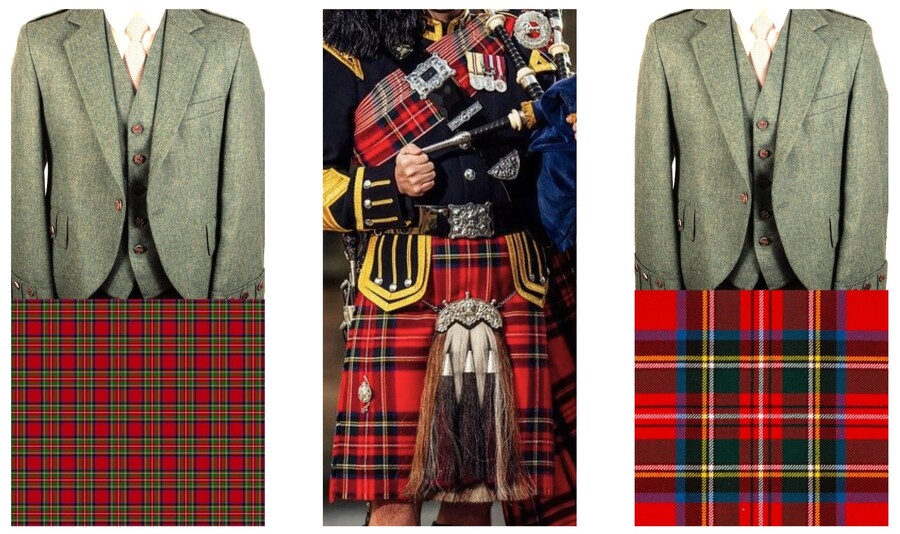
It art design the concept is called "scale". Put simply, the design that works on a penny and the design that works on a wall mural are going to be different because of the different sizes of format.
With tartan we're talking, in the main, the scale of a man's kilt.
Royal Stewart too small, too big, what the military considers just right.
Originally Posted by jsrnephdoc
...the notion of symbolism....the notion of a design being commemorative...
These are the sort of non-tartan considerations I was talking about.
To a Highlander in the old days the idea that the pattern of the tartan they were wearing symbolised something or commemorated something would be incomprehensible.
It's like somebody 300 years in the future imagining that the patterns on 20th century automobile tyres commemorated something.
It has been said that one cannot serve two masters. Tartans being the slave to resembling a flag, or being limited to a specific list of colours, impinges on the ability of the designer to make a nice tartan.
It's the modern "fashion" tartans, tartans designed to look attractive and for that purpose alone, that retain the original spirit of tartan design. An example is Edgar's "Hebridean" range of fashion tartans. (Oddly some traditional tartans appear among the new fashion tartans there.) https://www.houseofedgar.com/product...idean-tartans/
An interesting modern example of not putting the cart before the horse is what House of Edgar did in the 1980s. Their tartan designer came up with 32 lovely tartans, the colours and patterns chosen simply for attractiveness, and not symbolising anything.
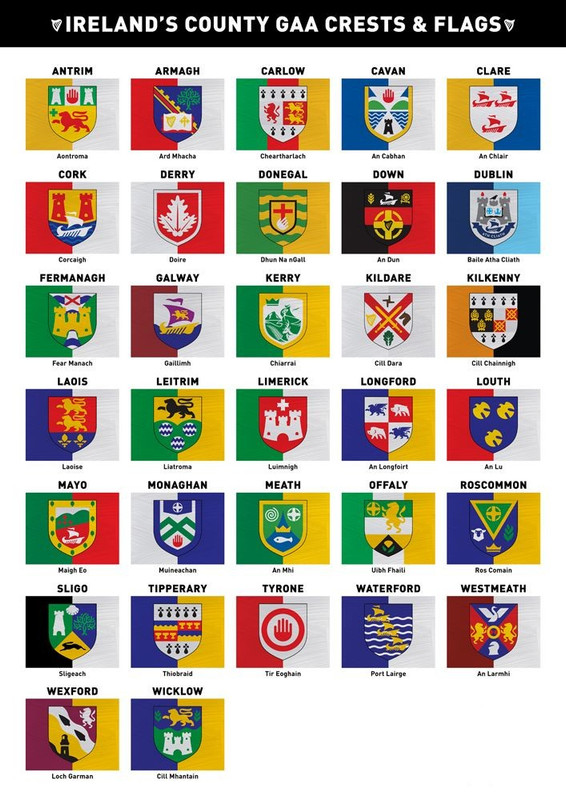
These 32 tartans were then assigned to the various Irish Counties, resulting in Edgar's commercially successful Irish County tartans range. https://www.houseofedgar.com/product...ounty-tartans/
Now, each Irish County does have colours strongly associated with it in modern times, but the Edgar tartans paid no heed to these whatsoever.
Sometime later another designer came along and made 32 tartans slavishly copying these Irish County colours, these tartans being rather unattractive (as they must be) and having far less commercial success.
(Irish County GAA colours)
Last edited by OC Richard; 30th March 26 at 04:28 PM.
Proud Mountaineer from the Highlands of West Virginia; son of the Revolution and Civil War; first Europeans on the Guyandotte
-
 Posting Permissions
- You may not post new threads
- You may not post replies
- You may not post attachments
- You may not edit your posts
-
Forum Rules
|
|








 Reply With Quote


Bookmarks