|
-
13th August 12, 01:26 PM
#131
I'm in the middle of doing a box pleated kilt from 6 yards of cloth right now. I just finished sewing in all the pleats but have not done anything else yet. I think this is a good opportunity for me to take some photos to show how this is done. It's also good because at 6 yards, it is half way between the original historic box pleated kilt of four yards, and the more modern regimental box pleated kilts, which would contain closer to 7 or 8 yards of cloth.
Stay tuned....
-
-
13th August 12, 03:29 PM
#132
Ok, I have uploaded some pictures of this work in progress in a new thread in the Kiltmaker's Tips section. Check it out.
http://www.xmarksthescot.com/forum/f...-making-75409/
-
-
14th August 12, 09:44 AM
#133
 Originally Posted by M. A. C. Newsome

The link you provided appears broken, but one can find the page by going to the Keltoi link in the advertisers section and finding the military box pleated kilt in the menu. This is a military (regimental) box pleated kilt, and NOT the barrel pleated kilt described in Bob Martin's book.
If the kilt you have looks like this, then it is a regimental box pleated kilt. If the kilt you have had the pleats running in the opposite direction of a normal kilt and appears to have a twist at the hip, then it is a barrel pleated kilt.
Right, and that's what I was talking about, but I digress.
Everything in excess! To enjoy the flavor of life, take big bites. Moderation is for monks. From the note books of Lazurus Long aka: Woodrow Wilson Smith
-
-
15th August 12, 05:37 PM
#134
-
-
15th August 12, 07:07 PM
#135
What you are describing, Steve, is exactly how I was taught to make them. While the method Matt describes will produce a somewhat similar effect, the construction details are obviously quite different.
I don't normally do on-line pictorials, but here's a quick demonstration using a scrap piece of 16 oz. Irish National:
1) I've decided to pleat this using the narrow gold line within the green.

2) Fold the pleat along what will become the right side of the facing. (In this case, exactly where the green meets the narrow black stripe.)

3) Fold the pleat back onto itself revealing the gold line initially selected. Fold the pleat again on the left side where the green meets the narrow black stripe.

4) Select the next pleat and Repeat Step 2

5) Repeat Step 3

6) Sew the pleats to each other and through the backing cloth as well, creating a flat-felled seam.

7) Here is the bottom of an Argyll and Sutherland kilt I made in 18 oz. cloth. You will see that the bottom is the same as Steve has shown in his example.

While I just used pins in my quick mock-up, ordinarily one would bast the entire pleat length vertically before sewing. Once finished, the rest of the construction is identical to that of your typical high-yardage knife-pleated kilt.
I hope this helps everyone. As I said, I'm not much given to tutorials, but there seems to be a great deal of misunderstanding about this style of pleating.
[B][COLOR="DarkGreen"]John Hart[/COLOR]
Owner/Kiltmaker - Keltoi
-
-
15th August 12, 07:11 PM
#136
'Rarely seen' in the civvie world, Richard. Obviously not in the army, as several of our regiments wear them here in Canada.
Last edited by slohairt; 15th August 12 at 07:11 PM.
[B][COLOR="DarkGreen"]John Hart[/COLOR]
Owner/Kiltmaker - Keltoi
-
-
15th August 12, 07:58 PM
#137

Thank you, Mr. Hart.
Mister McGoo
A Kilted Lebowski--Taking it easy so you don't have to.
-
-
15th August 12, 08:13 PM
#138
This has been a great thread, thanks to LitTrog for starting it and to all the contributors who have added such a wealth of knowledge and  to you all to you all
Shoot straight you bastards. Don't make a mess of it. Harry (Breaker) Harbord Morant - Bushveldt Carbineers
-
-
16th August 12, 04:49 AM
#139
Originally Posted by The Wizard of BC
To my eye this type of pleating is quite different from the asymmetrical box pleat that Matt is describing. Maybe Matt can chime in here and clarify if we are doing the same thing but describing it differently.
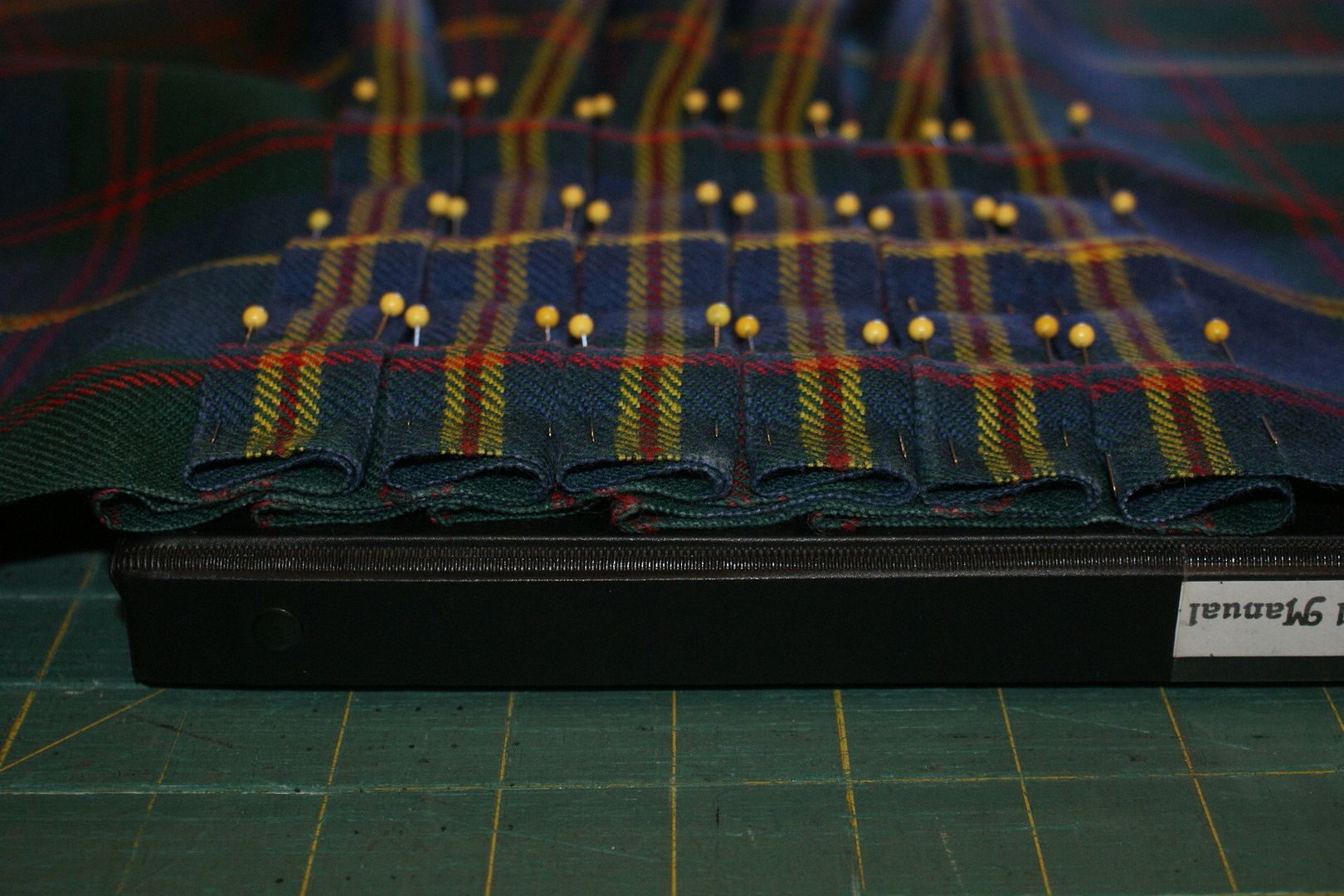
To my eye, Steve, your pics show the exact same type of pleat. I'm not sure I understand what the difference is you are seeing. You and I may have taken a different route to get there, but we ended up in the same place. When I am done with this kilt I will have to get a "bottom up" photo from the same angle as yours here, and you'll see the only difference is that the pleats in the six yard kilt are a little wider.
Last edited by M. A. C. Newsome; 16th August 12 at 04:59 AM.
-
-
16th August 12, 04:58 AM
#140
Originally Posted by slohairt
What you are describing, Steve, is exactly how I was taught to make them. While the method Matt describes will produce a somewhat similar effect, the construction details are obviously quite different.
...
I hope this helps everyone. As I said, I'm not much given to tutorials, but there seems to be a great deal of misunderstanding about this style of pleating.
Thanks, John. The method you show is different from what I do, and I believe would be easier to manage when using a full eight yards to make a kilt. As I told Steve, we may take different routes but we are ending up in the same place.
I just want to underscore the fact that using different construction methods in kilt making is nothing new and does not really have any impact on defining a pleat style one way or another. I'm sure Lady Chrystal makes Kingussie pleated kilts differently than I do, but they are still Kingussie pleats. Kilt makers doubtless have different methods for making standard knife pleated kilts, but we don't try to subcategorize these into different pleating styles.
My original point in this thread is that "box pleated" and "military box pleated" are not two distinct types of pleating, but rather the same basic type of pleating made with different amount of cloth. A "military box pleated kilt" is simply what a box pleated kilt made from eight yards of cloth looks like. The different construction techniques that you, Steve and I have shown are all made necessary because of the amount of cloth. The construction techniques used to make a four yard box pleated kilt won't work (similarly there are different techniques you'd use in making a four yard knife pleated kilt vs. an eight yard knife pleated kilt).
I hope this thread has been educational for folks, and it doesn't seem too much like crotchety old kiltmakers arguing over unimportant details. :-)
-
Tags for this Thread
 Posting Permissions
- You may not post new threads
- You may not post replies
- You may not post attachments
- You may not edit your posts
-
Forum Rules
|
|





Bookmarks