|
-
To know the colours you wouldn't need to see Robertson woven, just a swatch of tartan that has the same colours.
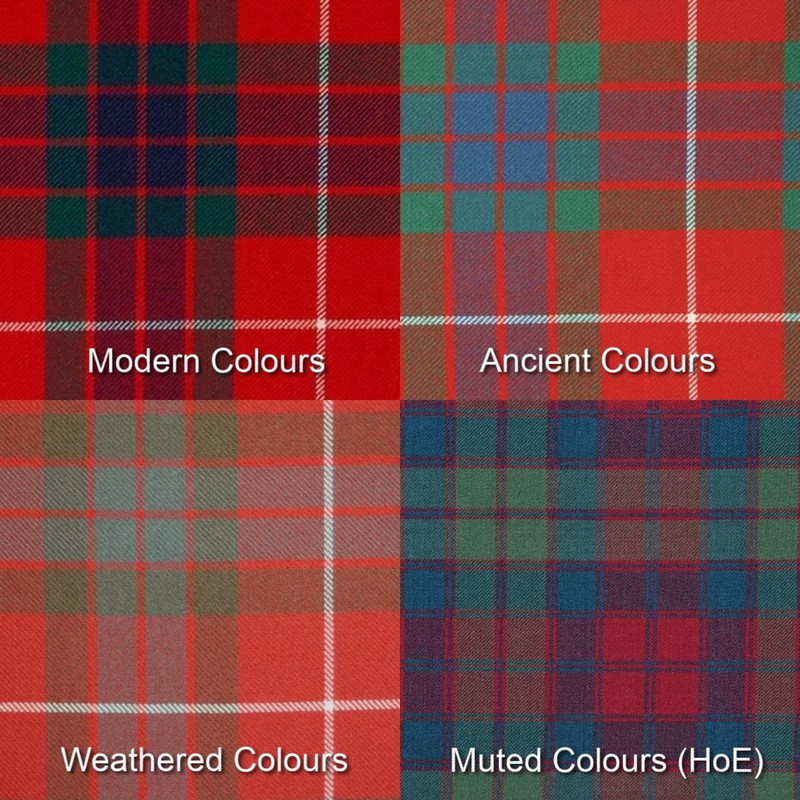
I put this together a while ago. I spent some time adjusting the colour of each individual image until it exactly matched a physical swatch in front of me, illuminated with 100% natural light coming in through a big window.
With Robertson (red) the players are red, blue, and green. There are plenty of tartans having those colours, such as these.
I'm a fan of House of Edgar's "muted range" especially with tartans having large areas of red. To me the "muted" red is beautiful.
Proud Mountaineer from the Highlands of West Virginia; son of the Revolution and Civil War; first Europeans on the Guyandotte
-
-
About weavers, there's a woman who has a booth every year at the Pleasanton Highland Games (East Bay Area, California).
She has tons of different yarn colours and seems to specialise in small runs of tartan.
I'll look through some old programmes and see if she's listed.
Proud Mountaineer from the Highlands of West Virginia; son of the Revolution and Civil War; first Europeans on the Guyandotte
-
-
That might really help!
 Originally Posted by OC Richard

About weavers, there's a woman who has a booth every year at the Pleasanton Highland Games (East Bay Area, California).
She has tons of different yarn colours and seems to specialise in small runs of tartan.
I'll look through some old programmes and see if she's listed.
I've been to those games (back when I lived in Santa Rosa). Probably shortly after I obtained my very first kilt that really belonged to ME.
But I didn't see anyone exhibiting with a loom, and I'd be very interested. As for why I'd need to see the "white line" Robertson Red "in the cloth," I probably wouldn't because I'm well enough acquainted with the usual Robertson Red, but in my discussion with Peter it came to me that creating a swatch-sized piece of rare or uncommon tartan might be a way to reduce the "ouch" factor of a 10 or 30 meter weave that comes out VERY differently from what the purchaser anticipated
And, I still think that imaging technology has advanced enough that the mills, retailers, and perhaps the web wranglers for the SRT or STA, could use it to better advantage for creating their electronic swatches, perhaps even to be deposited in a shared database. Given how many tartans they inventory it would not be accomplished by a quick run to the local Apple Store for their top-end $3400 monitor and a few hi-res photos taken in daylight, but it could be done.
-
-
True enough . . . but the rest of us probably don't want to spend the cash for a laptop with that quality of monitor, especially considering their life expectancy. Thus: the same problem as before, so why would the weavers bother?
Rev'd Father Bill White: Mostly retired Parish Priest & former Elementary Headmaster. Lover of God, dogs, most people, joy, tradition, humour & clarity. Legion Padre, theologian, teacher, philosopher, linguist, encourager of hearts & souls & a firm believer in dignity, decency, & duty. A proud Canadian Sinclair.
-
-
About two years ago I did the same thing - made a collage of all the variations of MacLean of Duart. These are HoE swatches.

-
-
Originally Posted by SF Jeff
About two years ago I did the same thing - made a collage of all the variations of MacLean of Duart. These are HoE swatches.
The thing about contemporary palettes is that they use uniform shades across the individual palettes: Modern; Ancient; Weathered; Muted etc. What none of them do is replicate the older palettes, such as Wilsons of Bannockburn's, where individual colours are balanced in a visually more pleasing way by using bright reds, dark blues and mid-greens.
This example of MacLean of Duart dates to 1815 - Photo: National Museum of Scotland.

-
The Following 2 Users say 'Aye' to figheadair For This Useful Post:
-
Originally Posted by figheadair
............ What none of them do is replicate the older palettes, such as Wilsons of Bannockburn's, where individual colours are balanced in a visually more pleasing way by using bright reds, dark blues and mid-greens.
This example of MacLean of Duart dates to 1815 - Photo: National Museum of Scotland.
Personally, I wish the weavers would get back to the" older palettes" and "visually pleasing way of using bright reds, dark blues and mid -greens." to replicate the "older patterns." The sooner the better in my view.
Last edited by Jock Scot; Today at 04:56 AM.
" Rules are for the guidance of wise men and the adherence of idle minds and minor tyrants". Field Marshal Lord Slim.
-
The Following 4 Users say 'Aye' to Jock Scot For This Useful Post:
-
 Now my ignorance is REALLY on display! Now my ignorance is REALLY on display!
Originally Posted by figheadair
The thing about contemporary palettes is that they use uniform shades across the individual palettes: Modern; Ancient; Weathered; Muted etc. What none of them do is replicate the older palettes, such as Wilsons of Bannockburn's, where individual colours are balanced in a visually more pleasing way by using bright reds, dark blues and mid-greens.
This example of MacLean of Duart dates to 1815 - Photo: National Museum of Scotland.
What about the colors in the yarns HoE used to do the "Genesis" tartans? Are they maintaining those in inventory for continued use, and would some of those replicate Wilson's colors? I have a vague recollection of reading here that Strathmore was involved in weaving some Wilson's colors fabrics. However, when I visit their website, quick perusal doesn't find a discussion of same, and when I search on my own family name, their Robertson "modern" appears not even to INCLUDE any green (which is present in their electronic swatch of "OC" fabric). I'm assuming, but don't know from what I read there, that "OC" means "old colors," but I have no idea HOW old to infer from that designation. Also, as others have pointed out, they don't sell heavyweight kilting fabric. And, just to persevere with my probably wacko idea of getting a hobbyist weaver to produce a fabric sample, is it likely or not possible that a mill would sell small quantities of the yarns they use so the the hobbyist could SEE how they would balance in a tartan they don't currently weave?
Last edited by jsrnephdoc; Today at 08:45 AM.
Reason: clarity, more information
-
-
Originally Posted by Father Bill
True enough . . . but the rest of us probably don't want to spend the cash for a laptop with that quality of monitor, especially considering their life expectancy. Thus: the same problem as before, so why would the weavers bother?
The "catalog" department at my former employer had the stupid expensive monitors and matching graphics cards... and the calibration software with the calibration "eye" and the color wheels. Countless hours were spent calibrating the monitors.
Like light bulbs change color temperature as they age, so do stupid expensive monitors. More hours calibrating.
Send the digital catalog off to the printer. Hold the printed page up to the monitor - they're not the same, ever.
Last edited by MacKenzie; Today at 12:29 PM.
Tulach Ard
-
 Posting Permissions
- You may not post new threads
- You may not post replies
- You may not post attachments
- You may not edit your posts
-
Forum Rules
|
|





 Reply With Quote




Bookmarks