|
-
3rd April 26, 12:14 PM
#1
 All in the (Robertson) Family (the tartan, not the TV comedy) All in the (Robertson) Family (the tartan, not the TV comedy)
I own (and wear) 4 different Robertson tartan kilts. NONE of them are in the instantly-recognized Robertson Red (modern) tartan, because it's always just seemed to me to be just TOO MUCH RED:

However, on the SRT website there's another red, this one containing a narrow white stripe placed between the pair of narrow green ones in the standard red. It looks more attractive to me, but I just realized that the online comparison may not be "fair" because the jpegs available there suggest the sett sizes may differ, and I have no way of knowing whether that's an artifact of electronic imaging or a real difference.

I'm assuming that someone with an actual account on the SRT system would be able to look at thread counts and infer whether that difference is real in the fabric or not.
I've read (on its placeholder page) that the STA will have an active website welcoming traffic in just a few more days, and that might be a place I could get this question answered, but I'm guessing that some of the knowledgeable folk here would be able to answer this simple question.
And, of course, the reason it cannot be answered just by comparing swatches is because no one has woven the Robertson Red (white line) tartan for a LONG time.
And, while we're at it, I have one other related question. There are also two "fashion" Robertson tartans that look TOTALLY different, giving MUCH more prominence to white and green. They were designed by DC Dalgliesh, and I find them attractive, too, but I have no idea whether with the demise of DC Dalgliesh they're restricted.
One answer to my final questions might be "all you need to do is register an account at the SRT website, but as best I can tell doing so would cost me £ 85, and after I paid that I'd still have no idea what to do with the information, nor would I learn about restrictions on someone other than (perhaps) the purchaser of DC Dalgliesh's intellectual property (assuming someone has done so) being able to weave those Dalgliesh designs.
Thanks in advance for any answers!
-
-
5th April 26, 02:33 AM
#2
[QUOTE=jsrnephdoc;1414451]I own (and wear) 4 different Robertson tartan kilts. NONE of them are in the instantly-recognized Robertson Red (modern) tartan, because it's always just seemed to me to be just TOO MUCH RED:
However, on the SRT website there's another red, this one containing a narrow white stripe placed between the pair of narrow green ones in the standard red. It looks more attractive to me, but I just realized that the online comparison may not be "fair" because the jpegs available there suggest the sett sizes may differ, and I have no way of knowing whether that's an artifact of electronic imaging or a real difference.
I'm assuming that someone with an actual account on the SRT system would be able to look at thread counts and infer whether that difference is real in the fabric or not.
I've read (on its placeholder page) that the STA will have an active website welcoming traffic in just a few more days, and that might be a place I could get this question answered, but I'm guessing that some of the knowledgeable folk here would be able to answer this simple question.
And, of course, the reason it cannot be answered just by comparing swatches is because no one has woven the Robertson Red (white line) tartan for a LONG time.
And, while we're at it, I have one other related question. There are also two "fashion" Robertson tartans that look TOTALLY different, giving MUCH more prominence to white and green. They were designed by DC Dalgliesh, and I find them attractive, too, but I have no idea whether with the demise of DC Dalgliesh they're restricted.
One answer to my final questions might be "all you need to do is register an account at the SRT website, but as best I can tell doing so would cost me £ 85, and after I paid that I'd still have no idea what to do with the information, nor would I learn about restrictions on someone other than (perhaps) the purchaser of DC Dalgliesh's intellectual property (assuming someone has done so) being able to weave those Dalgliesh designs.
Thanks in advance for any answers!
I have no idea I am afraid, those details pass me by.
" Rules are for the guidance of wise men and the adherence of idle minds and minor tyrants". Field Marshal Lord Slim.
-
-
5th April 26, 04:16 PM
#3
Peter would have the full answers.
The Setts of the Scottish Tartans (sorry Peter) says the one with the white line, and all the narrow flanking lines blue, appears in "early collections".
Logan (1831) gives the version with the white line changed to red, and the narrow flanking lines alternating green and blue. (Your upper swatch keeps them all blue.)
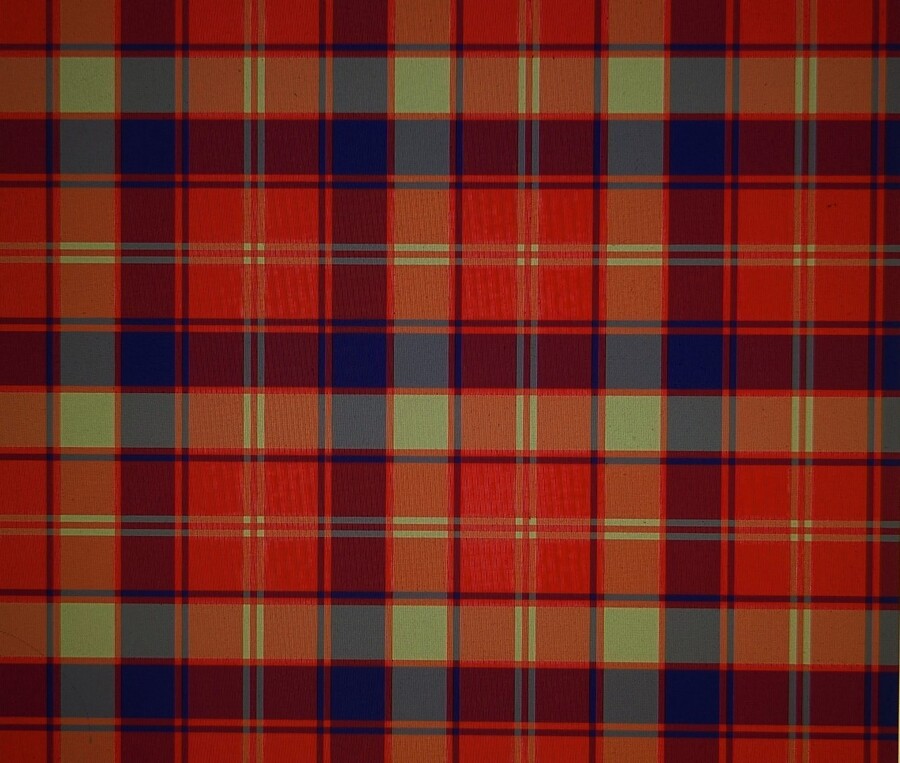
Now leaving Setts, the Wilsons 1819 Key Pattern Book gives a version with no white. It has three colours: Scarlet, Green, and the colour Wilsons called 'Purple' ("a dark Navy with slight reddish tint"). Wilsons' note says "This is the real Clan Donnachy or Robertson of Strouans tartan."
Here's a quick computer-generated image of the Wilsons' Robertson thread count. I used the pale green sometimes seen with Wilsons tartans.
About sett size, that's independent of the sett. The weaver takes the thread count and does the maths to scale it up or down to create the sett-size they want.
You can purchase the Wilsons 1819 Key Pattern Book and get all the old Wilsons thread-counts, and The Setts Of The Scottish Tartans to get the thread-counts of the most commonly-seen Clan tartans.
Armed with these and with a free online tartan generator you can create images of most of the older Clan tartans.
Last edited by OC Richard; 6th April 26 at 07:28 AM.
Proud Mountaineer from the Highlands of West Virginia; son of the Revolution and Civil War; first Europeans on the Guyandotte
-
-
5th April 26, 09:20 PM
#4
Tartan sett
 Originally Posted by OC Richard

About sett size, that's independent of the sett, and is merely the choice of the weaver.
For example the pipers of some regiments wore three different sizes of Royal Stewart in their uniform including their pipes.
My (apparently incorrect) understanding was that sett size was determined by the thread count and yarn weight, and that thread count was a major descriptor of a registered tartan. Is that not the case?
-
-
6th April 26, 06:46 AM
#5
Originally Posted by jsrnephdoc
My (apparently incorrect) understanding was that sett size was determined by the thread count and yarn weight, and that thread count was a major descriptor of a registered tartan. Is that not the case?
Right, but say you're going to use finer thread which if you use the same thread-count results in a sett size smaller than you want. So you increase the thread-count to make the sett size come out bigger.
In other words there's not a one-and-only thread count, there are as many thread-counts as weavers need to generate all the tartan weights and sett-sizes they want to create.
They keep more or less the same proportions, but not necessarily exactly the same.
Not being a weaver, the part that I don't fully understand is the number of "reeds" that the tartan will be woven using, which means changing the thread count.
You see this all over the 1819 Key Pattern Book, because they're weaving the same tartan in different kinds of yarn, and creating tartan for various purposes.
The easiest example in the KPB to give is Rob Roy for which 8 different thread-counts are given:
S K (S=scarlet, K=black)
85 86
57 57
34 34
31 31
156* 158
128* 124
106* 104
80* 78
(* I've added two Scarlet stripes together)
42nd Royal Highland Regiment (Black Watch) tartan has 9 different thread-counts given, with the precise use of each written out:
-Officers' Plaids
-Sergeants' Plaids
-Privates' Plaids
-Coarse Kilts
-Fine Kilts, Large Sett 4 green turns
-Fine Kilts, Small Sett 7 green turns
-Fine Plaids, 4 half-sets
-Fine Plaids, 5 half-sets
-Fine Plaids, 6 half-sets
So, you say, wouldn't the soldiers' kilts and plaids be made from the same cloth, like we do nowadays?
No, that wasn't how it was done in the Victorian Scottish regiments.
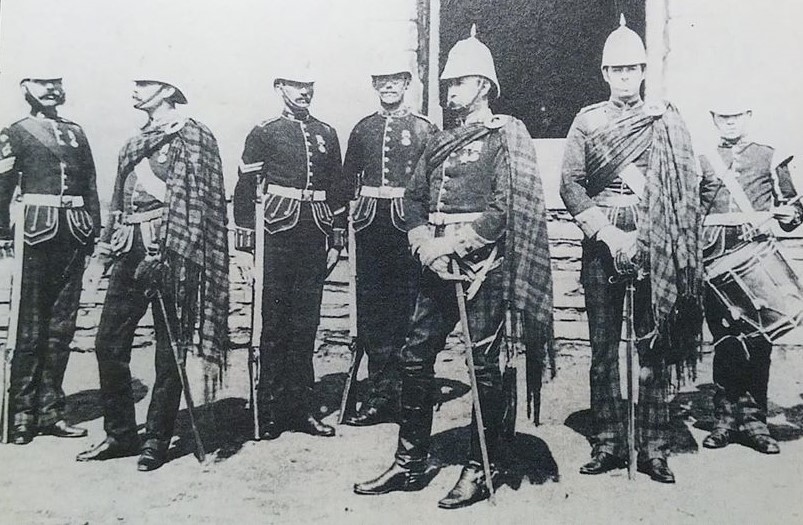
Here in 1882 you can see that the officers' riding breeches and trousers are made from the heavy stuff used for kilts, with dark colours, and their plaids made from fine lightweight stuff, and lighter colours:
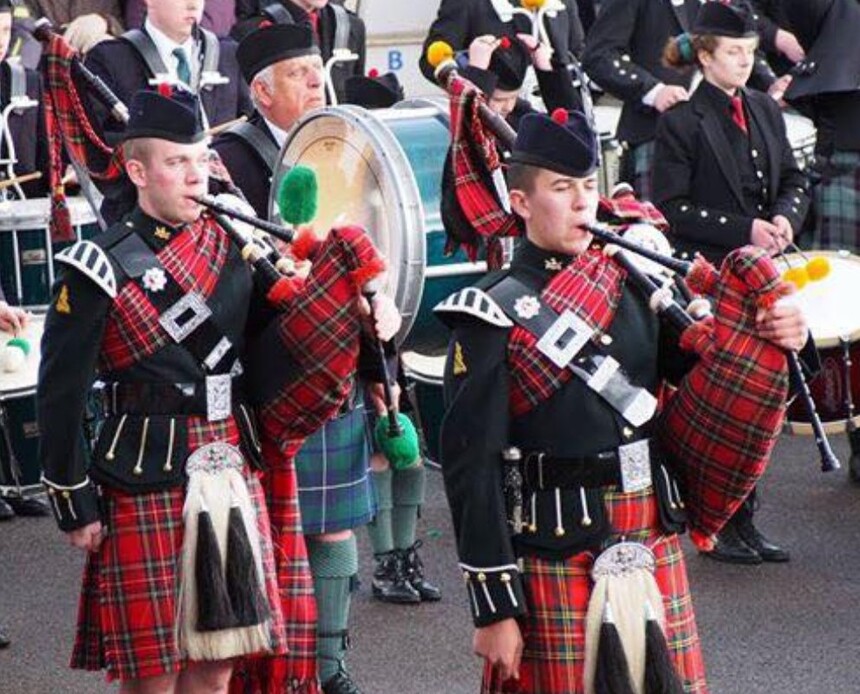
Here's an interesting modern example. As far as I know, all the British military pipers who wore Royal Stewart (Scots Guards, Royal Scots Dragoon Guards, Royal Scots, Kings Own Scottish Borderers, Black Watch) used the same extra-heavyweight big-sett cloth for their Other Ranks kilts. (The Pipe Majors would often wear civilian-style cloth, a bit lighter weight, a bit smaller sett.)
If they used Royal Stewart tartan bag-covers they would generally be woven in a smaller sett, and sometimes the plaids would be as well.
In this photo the 1SCOTS piper on the right is wearing a kilt in the extra-heavy big-sett stuff, with his bag-cover and plaid of the lighter-weight smaller-sett stuff.
But the piper on the left has his kilt made out of the lighter stuff too. More recent photos of 1SCOTS show all their pipers wearing these lighter-weight kilts, very odd, because the other regiments have continued to wear the traditional big-sett stuff.
Last edited by OC Richard; 6th April 26 at 07:46 AM.
Proud Mountaineer from the Highlands of West Virginia; son of the Revolution and Civil War; first Europeans on the Guyandotte
-
The Following User Says 'Aye' to OC Richard For This Useful Post:
-
6th April 26, 11:20 AM
#6
Originally Posted by OC Richard
Right, but say you're going to use finer thread which if you use the same thread-count results in a sett size smaller than you want. So you increase the thread-count to make the sett size come out bigger.
In other words there's not a one-and-only thread count, there are as many thread-counts as weavers need to generate all the tartan weights and sett-sizes they want to create.
They keep more or less the same proportions, but not necessarily exactly the same.
Not being a weaver, the part that I don't fully understand is the number of "reeds" that the tartan will be woven using, which means changing the thread count.
You see this all over the 1819 Key Pattern Book, because they're weaving the same tartan in different kinds of yarn, and creating tartan for various purposes.
Perhaps THAT explains (or hints at) why there's both an STA and an SRT and at least one other group that attempts to codify it all (Welcome to the new STA Website)!
So, if the "sett" defines a tartan, could two different mills use different multiples or additions to the number of threads per stripe, almost of necessity not exact multiples, but still weave tartan that bears exactly the same name in their catalogs? Up until this discussion, my limited comprehension of this was that tartan WAS defined by thread counts and that colors really didn't matter much in comparison. Let's for example discuss a tartan where there are four colors, and the sett is described by a thread count of 2, 7, 13, 5. Pretty hard to make enlargements or reductions in exact proportions.
I've started reading the stuff on the new STA website, and I've already noticed that "Robertsons" were quarreling with one another even at the very beginning of attempts to use tartan as a property of families!
-
-
7th April 26, 06:51 AM
#7
The proportions can change a bit and still be considered the "same tartan".
For example you can see several examples of Royal Stewart woven by different mills and the relative size of the open red square will vary.
For Robertson, the Wilsons 1819 Key Pattern Book gives four thread-counts.
You can see that the proportions aren't exactly the same.
Note that they're all even numbers except for the "pivot" stripes which can be even or odd. Since Wilson reckoned the pivot as being in the middle of a stripe, you have to double the pivots, ending up with an even number for the entire stripe.
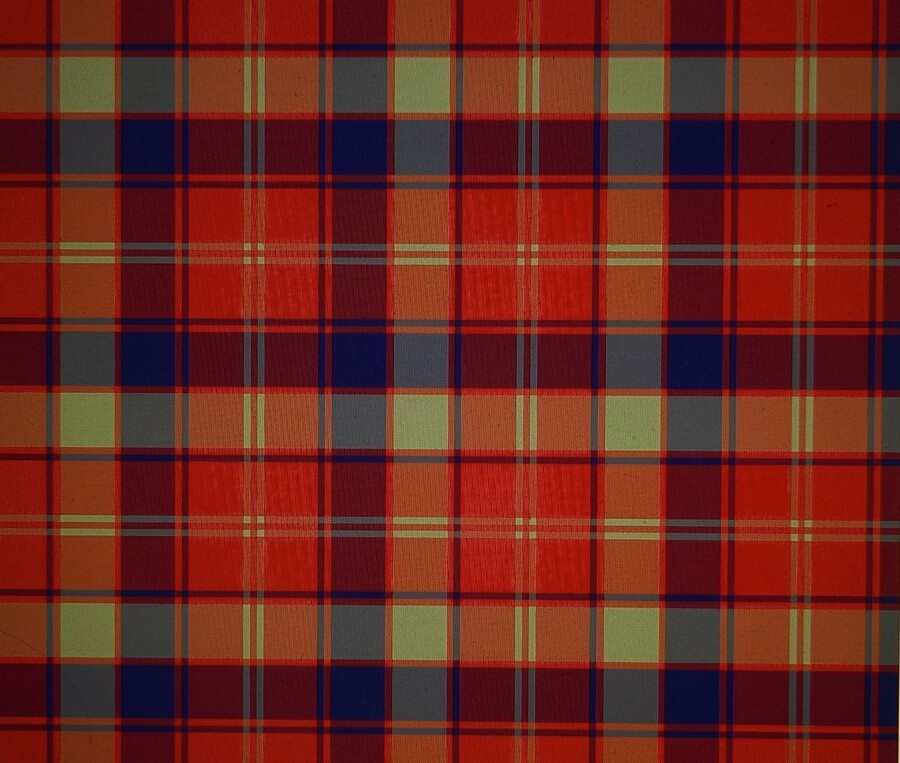
Here's two of the Robertsons compared (the first and last are the pivots, which I believe are, in effect, two halves of the same Scarlet stripe).
S G S.. P S G. S P. S P S. G S
3 6 70 6 6 70 6 70 6 6 70 6 3
3 6 56 6 6 56 6 56 6 6 56 6 3
The bottom one, with the wide stripes not as wide, is what I used to generate this image
Tartan proportions have changed over the years.
Donald C Stewart says in The Setts of the Scottish Tartans
"Changes of fashion are to be observed in the relative proportions...many of the thread-counts in Logan (1831) seem weak when compared to recent examples: the fine lines are finer, and the open spaces more open...
Unfortunately there has been a tendency in recent years towards a thickening of the patterns, giving a clumsy and congested effect. Greater refinement does not always entail weakness."
Last edited by OC Richard; 7th April 26 at 07:48 AM.
Proud Mountaineer from the Highlands of West Virginia; son of the Revolution and Civil War; first Europeans on the Guyandotte
-
-
7th April 26, 08:56 AM
#8
 Now, THAT clears things up Now, THAT clears things up
Originally Posted by OC Richard
Donald C Stewart says in The Setts of the Scottish Tartans
"Changes of fashion are to be observed in the relative proportions...many of the thread-counts in Logan (1831) seem weak when compared to recent examples: the fine lines are finer, and the open spaces more open...
Unfortunately there has been a tendency in recent years towards a thickening of the patterns, giving a clumsy and congested effect. Greater refinement does not always entail weakness."
Stewart's prose sings rolling off the tongue, but I have NO idea what he means, precisely.
I cannot imagine the "discussions" when someone seeks to register a new tartan. Just HOW different do the thread counts need to be? Must there also be variations in the sequence of stripes? If color is not a determinant, how are comparisons with already registered tartans initiated?
I REALLY appreciate the time you take to try to bring us newbies up to speed on an incredibly complex subject.
-
-
8th April 26, 08:11 AM
#9
He's just talking about subtle changes in proportion.
EDIT: Here to show specifically with Robertson (using one of Wilsons' 1819 thread counts) what the author means by "attenuated" and "congested", is the thread count as given (centre) an attenuated version resembling some of the tartans in Logan 1831 and Vestiarium Scoticum 1842 (left) and a congested version as is often seen in modern tartans (right).
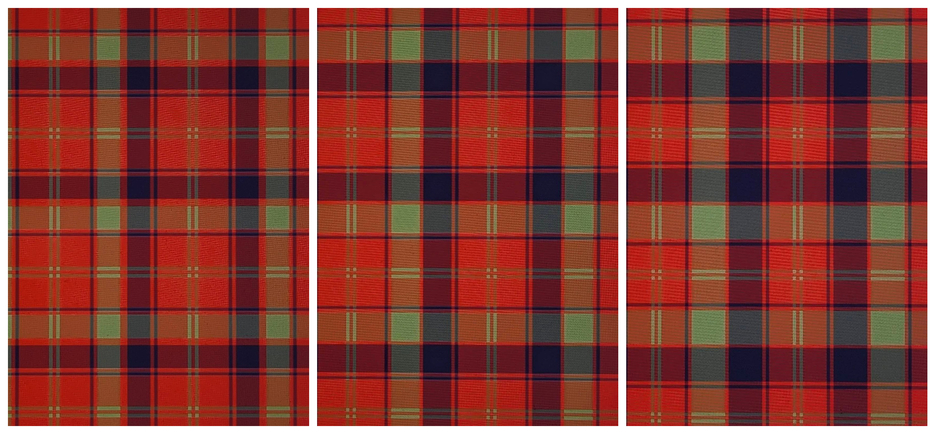
These are the sorts of changes seen from weaving to weaving over the years, and I think they'd all be recognised as Robertson.
Personally I like the attenuated versions of most tartans; they have a "vintage" feel to me.
The modern congested versions can start looking like Rubik's Cubes.
Sorry for the low-quality quick-and-dirty images.
Last edited by OC Richard; 8th April 26 at 09:02 AM.
Proud Mountaineer from the Highlands of West Virginia; son of the Revolution and Civil War; first Europeans on the Guyandotte
-
-
8th April 26, 08:29 AM
#10
Who knew? Certainly, not I
Originally Posted by OC Richard
He's just talking about subtle changes in proportion.
Just to see, I generated three different thread-counts of Prince Charles Edward Stuart tartan given in Wilsons 1819 Key Pattern Book, and compared it to an 18th century length of cloth from Glamis Castle (not like California).
While no two are quite the same, yet all can be recognised as the same tartan.

Although I was aware that my dad had a Robertson Red (modern) kilt, and borrowed my sister's kilt version of the "same" tartan during my college years attempting to actually PLAY the pipes, it wasn't until my sister sent me a picture of her, my dad, the clan chieftain, and two other ladies at a clan gathering in Pitlochry they had attended together several years earlier that I had ANY idea that there was more than just ONE variant of Robertson Red, and even when handed several swatch books to study when buying my own first kilt back in 2016 at Wm Glen & Son just off Union Square in SF the nature of or reasons for those differences didn't even register. But by then I knew that the Red (modern) was just TOO MUCH RED for me, so that kilt was Robertson Ancient Hunting.
-
Tags for this Thread
 Posting Permissions
- You may not post new threads
- You may not post replies
- You may not post attachments
- You may not edit your posts
-
Forum Rules
|
|





 Reply With Quote


Bookmarks