|
-
2nd July 26, 09:05 AM
#11
 Originally Posted by Father Bill

Here's the picture as you PMed it to me. Not sure what you're doing that doesn't work.

So...Would this fit with an A and SH piper of 1918/19 at all pse anyone??
-
-
2nd July 26, 09:52 AM
#12
Great photo!
Yes A&SH piper would be my guess, due to the grey sporran with black tassels and the shape of the cap-badge.
I wish we could see the sporran better, see the cantle, or see the cap badge better, either of which would give a positive ID.
Another thing we can't see, which would give a strong clue as to regiment, would be his flashes.
The Argylls and the Black Watch wore the same style of flashes, quite different to the Seaforths, Gordons, or Camerons.
Last edited by OC Richard; 2nd July 26 at 09:56 AM.
Proud Mountaineer from the Highlands of West Virginia; son of the Revolution and Civil War; first Europeans on the Guyandotte
-
The Following User Says 'Aye' to OC Richard For This Useful Post:
-
2nd July 26, 10:06 AM
#13

Originally Posted by OC Richard
Great photo!
Yes A&SH piper would be my guess, due to the grey sporran with black tassels and the shape of the cap-badge.
I wish we could see the sporran better, see the cantle, or see the cap badge better, either of which would give a positive ID.
Another thing we can't see, which would give a strong clue as to regiment, would be his flashes.
The Argylls and the Black Watch wore the same style of flashes, quite different to the Seaforths, Gordons, or Camerons.
Excellent thanks...I opined as much before joining, but I thought id better ask someone with better kilt/sporran knowledge than myself!
You can see what i meant with the hands being in just the wrong place!! 
-
-
2nd July 26, 04:45 PM
#14
The pic is attached to the thread in the subforum (click on the paper clip to the right of the post subject).
To get the pic to appear in the thread, you need to click on 'Insert Image' (second row of icons, 4th group to the right, third button) rather than 'Attachments'. If you're uploading from your computer, click on the 'Browse ...' button and find your pic. Once you have selected the image, you need to click on 'upload image' below the 'Browse ...' button.
John
-
The Following User Says 'Aye' to EagleJCS For This Useful Post:
-
4th July 26, 03:54 PM
#15
Originally Posted by Scrimmers
So...Would this fit with an A&SH piper of 1918/19?
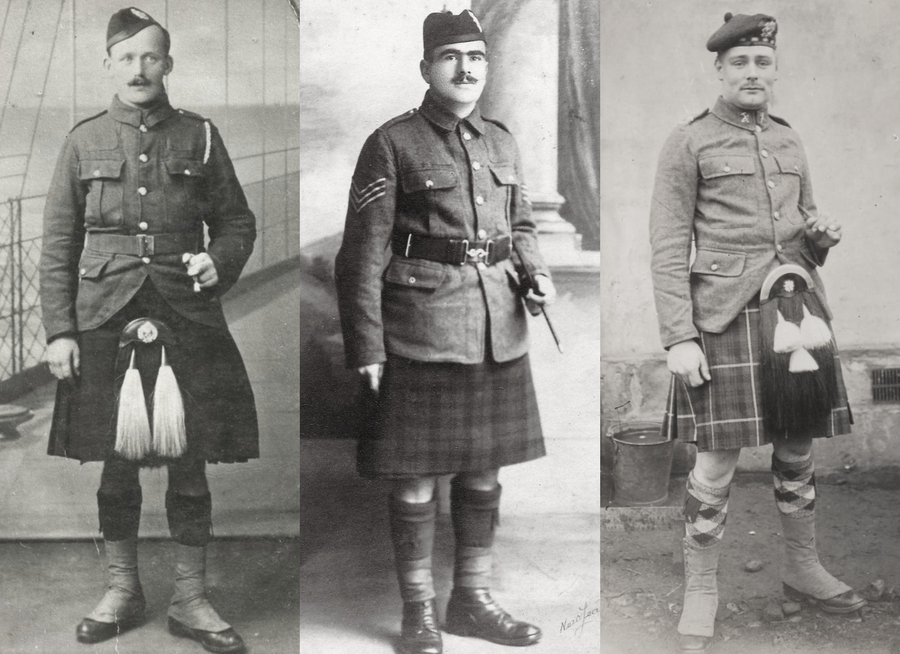
Yes, that khaki service dress tunic was introduced in 1908, and that khaki Tam O Shanter was introduced in 1914, so any time from 1914 up to around 1918 with that "snake" buckle (with leather belt) was phased out.
It looks to me like his tunic is the ordinary British style which has been modified by folding back the lower front panels.
There was a dedicated Scottish style tunic with curved cutaway lower front panels (left) though many Scottish soldiers were issued the ordinary British type (centre) which were often turned back (right).
Last edited by OC Richard; 4th July 26 at 04:27 PM.
Proud Mountaineer from the Highlands of West Virginia; son of the Revolution and Civil War; first Europeans on the Guyandotte
-
The Following User Says 'Aye' to OC Richard For This Useful Post:
-
5th July 26, 08:40 AM
#16
Originally Posted by OC Richard
Yes, that khaki service dress tunic was introduced in 1908, and that khaki Tam O Shanter was introduced in 1914, so any time from 1914 up to around 1918 with that "snake" buckle (with leather belt) was phased out.
It looks to me like his tunic is the ordinary British style which has been modified by folding back the lower front panels.
There was a dedicated Scottish style tunic with curved cutaway lower front panels (left) though many Scottish soldiers were issued the ordinary British type (centre) which were often turned back (right).
Which the Pioneer bn is he from, far right with the Balmoral ??
-
-
What immediately caught my eye is the pose. It's more of a "fashion" pose rather than a "military" pose (my terms, can't think of a better way to descibe them). The way he is sitting, angled to the camera, legs crossed, hand in lap, smiling, etc. It's all very casual. Looks to me like he's in a civilian photographer's studio posing for a photo to be framed and displayed on grandma's mantle back home.
Military photos seem to be different, more "serious." Often standing straight, full uniform and regalia on display, no smiling, etc.
-
-
Yes the pose and expression is a bit of an outlier as military photos go.
Generally they're standing and expressionless. I think the idea is to look "soldierly" to the folks back home.
I do have a WWI photo of a Highland sergeant elegantly seated like our man here, though with the typical expressionless face.
And I have a photo of a smiling young soldier, though standing.
What our photo here doesn't look like is the type I call "play dress-up photos", typically American soldiers on leave in Scotland who go into a studio and pose in the clothes and accessories the photographer has to hand for that purpose.
These often have big smiles and/or the brandishing of weapons. They're fascinating to study due to generally having a mix of civilian and military items, and within the military items a mix of ranks and regiments.
I did a thread years ago I called "soldier, or poser?" where the game was to distinguish the "dress-up" photos from actual military photos. My links are all dead, so just now I started something similar
https://www.xmarksthescot.com/forum/...81#post1415581
Last edited by OC Richard; Today at 06:40 AM.
Proud Mountaineer from the Highlands of West Virginia; son of the Revolution and Civil War; first Europeans on the Guyandotte
-
-
Originally Posted by SF Jeff
What immediately caught my eye is the pose. It's more of a "fashion" pose rather than a "military" pose (my terms, can't think of a better way to descibe them). The way he is sitting, angled to the camera, legs crossed, hand in lap, smiling, etc. It's all very casual. Looks to me like he's in a civilian photographer's studio posing for a photo to be framed and displayed on grandma's mantle back home.
Military photos seem to be different, more "serious." Often standing straight, full uniform and regalia on display, no smiling, etc.
I have about 4 to 5k photos of Toms in uniform...not many Scots though ☺️
They are in all sorts of relaxed and formal poses. Most are either in studios at home or taken by the peripatetic civilian photographers who roamed the rear areas of the battlefields with a small developing units.
Yours aye
Graham
-
 Posting Permissions
- You may not post new threads
- You may not post replies
- You may not post attachments
- You may not edit your posts
-
Forum Rules
|
|




 Reply With Quote


Bookmarks